



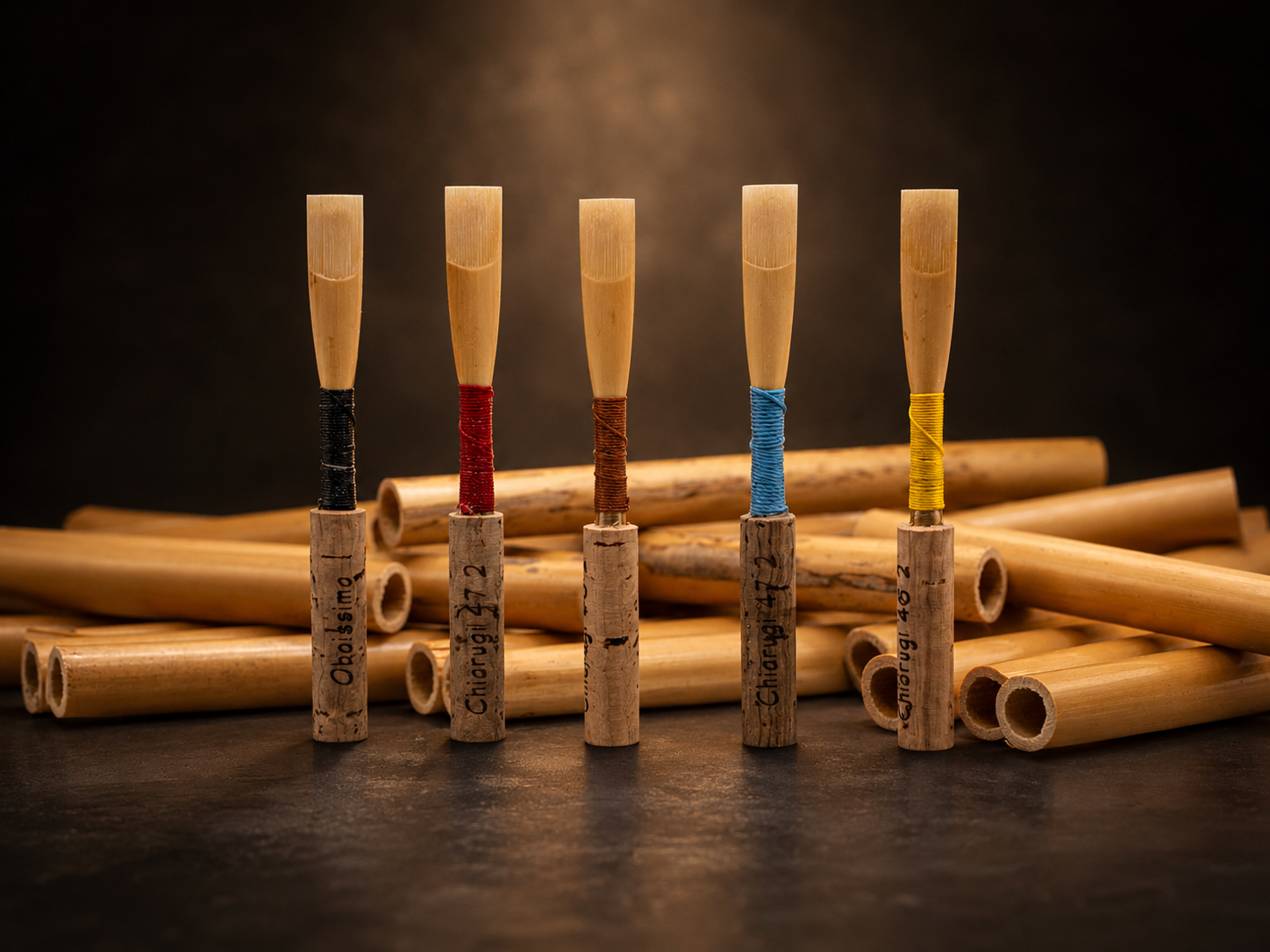
Choosing the right oboe reed can transform the way an instrument responds, sounds and feels. A suitable reed allows the player to concentrate on music rather than constantly fighting articulation, intonation or resistance.
However, there is no single oboe reed that is perfect for every player. The ideal combination depends on the oboist’s experience, embouchure, air support, instrument, tonal preference and playing environment.
After more than twenty years of playing professionally and making reeds, I have learned that choosing a reed should never be based on strength alone. Response, resistance, stability, flexibility, tone, shaper form and staple length all work together.
This guide will help you understand these characteristics and choose an oboe reed that supports the way you play.
1. Begin with Your Playing Level
The first step is deciding whether you need a student or professional reed.
This does not simply mean that a student reed is soft and a professional reed is hard. A well-designed student reed should support healthy playing habits, while a professional reed should offer greater tonal and dynamic possibilities without becoming unnecessarily demanding.
Student oboe reeds
A student reed should provide:
- comfortable and predictable response,
- secure articulation,
- reliable intonation,
- moderate resistance,
- stable low and high registers,
- and a natural playing feel.
The player should not need excessive embouchure pressure to produce a clear sound. Too much resistance can encourage biting, restrict the tone and make intonation more difficult.
A responsive reed also helps a student develop controlled air support because the instrument reacts clearly to changes in the air stream.
The Student Oboe Reed is intended for players who need a comfortable response, stable intonation and an effortless playing experience during lessons, practice and ensemble playing.
Professional oboe reeds
Advanced and professional oboists usually need a more refined balance between:
- response,
- resistance,
- flexibility,
- stability,
- projection,
- dynamic range,
- and tonal depth.
A professional reed should respond immediately, but it should also provide enough resistance to support the air column. It must remain stable during quiet entrances while allowing the player to produce a full sound in orchestral passages.
The Professional Oboe Reed is individually handmade from selected and tested cane and is available with several shaper forms and staple options.
2. Understand Response and Resistance
Response and resistance are closely connected, but they are not the same thing.
Response describes how quickly the reed begins to vibrate when the player starts a note.
Resistance describes how much support or pressure the player feels while blowing through the reed.
A reed can respond quickly while still providing a stable amount of resistance. This is often an ideal combination: the articulation feels easy, but the reed does not collapse when the player increases air pressure.
A reed may be too resistant when:
- attacks feel delayed,
- the low register is difficult to start,
- soft dynamics require excessive effort,
- the jaw becomes tired quickly,
- or the player feels that the sound is trapped inside the instrument.
A reed may have too little resistance when:
- the sound becomes thin or unstable,
- the pitch rises easily,
- the reed closes under stronger air pressure,
- dynamic control becomes limited,
- or the player feels there is nothing to support the air stream.
The goal is not to find the easiest possible reed. The goal is to find a reed that responds comfortably while still providing enough support for controlled and expressive playing.
3. Do Not Choose by Strength Alone
Terms such as soft, medium and hard can be useful, but they are not universal measurements.
A medium reed from one maker may feel harder or softer than a medium reed from another. Even two reeds made with the same dimensions may feel different because natural cane varies in density, hardness and flexibility.
The final playing resistance also depends on:
- the diameter of the cane,
- the thickness after gouging,
- the shaper form,
- the scrape,
- the opening,
- the staple,
- and the natural properties of the individual piece of cane.
For this reason, reed strength should be treated as a general starting point rather than an exact technical specification.
When choosing a strength, think about what you currently experience:
- Do your reeds feel too resistant?
- Do they close when you play loudly?
- Is the low register difficult?
- Does the pitch rise when you become tired?
- Are attacks unreliable?
- Does the sound lack depth or projection?
Answers to these questions are more useful than simply ordering a harder or softer reed.
4. Consider Tone and Tonal Flexibility
An oboe reed has a significant influence on tonal colour.
Some players prefer a dark, warm and rounded sound. Others need more brilliance, projection or directness. The right reed should support the player’s tonal concept while still allowing the sound to change with dynamics, register and musical character.
A reed with a beautiful tone but poor response will eventually become frustrating. Similarly, an extremely easy reed may not provide enough colour or stability for advanced playing.
A balanced reed should make it possible to:
- produce a warm and centred sound,
- articulate clearly,
- change dynamics without losing stability,
- shape phrases freely,
- and move between registers without a major change in tone.
The best reed is therefore not necessarily the darkest, loudest or easiest reed. It is the one that gives the player the greatest musical control.
5. Match the Reed to Your Oboe
The same reed can behave differently on two oboes.
Instrument bore, model, age, adjustment and natural intonation tendencies all influence how a reed performs. A reed that feels perfectly balanced on one instrument may sound too bright, feel too resistant or create intonation problems on another.
Before choosing a reed, consider:
- the brand and model of your oboe,
- whether the instrument generally plays high or low,
- which register feels least stable,
- whether the sound is naturally bright or dark,
- and how much resistance the instrument already provides.
For example, an instrument with a naturally free response may benefit from a reed with slightly more support. An oboe that already feels resistant may require a more responsive reed with a carefully balanced opening and scrape.
The reed and the instrument should work as one system.
6. Understand the Importance of the Shaper Form
The shaper form determines the outline of the folded cane and influences how the reed vibrates.
It can affect:
- tonal character,
- resistance,
- response,
- intonation,
- stability,
- projection,
- and flexibility.
However, a shaper form should never be evaluated in isolation. Its behaviour also depends on cane diameter, gouge, scrape, staple and the individual characteristics of the cane.
A wider shape does not automatically guarantee a darker sound, just as a narrower shape does not automatically produce better response. The complete reed design is what matters.
At oboe-reeds.com, professional reeds are available with several carefully selected shaper forms, including RC12, Bourgue, Angel, 901 and Rigoutat-2.
You can learn more about their playing characteristics in the Oboe Reed Shaper Form Guide.
Players who are uncertain about the best shape should begin with a balanced, versatile option and then compare how different shapes behave on their instrument.
7. Choose the Appropriate Staple Length
Staple length affects the total reed length and can influence response, pitch, stability and the relationship between the reed and the instrument.
The professional reeds at oboe-reeds.com are available on:
- a 46 mm staple with an approximate total reed length of 71 mm,
- or a 47 mm staple with an approximate total reed length of 72 mm.
Neither option is universally better.
The most suitable length depends on the oboe, the reed design and the player’s intonation needs. A difference of one millimetre may appear small, but on an oboe reed it can noticeably change the playing sensation.
When selecting a staple length, consider:
- your instrument model,
- your usual pitch tendency,
- the staple length you currently use,
- and whether your present reeds feel stable across all registers.
When in doubt, begin with the length that already works reliably on your instrument.
8. Remember That Cane Is a Natural Material
Every piece of Arundo donax cane is naturally different.
Even when cane is selected and processed according to consistent measurements, small variations in density, hardness, fibre structure and flexibility remain. These differences are part of the character of a handmade reed.
Humidity, temperature and altitude can also change the way a reed behaves.
A reed may feel more resistant in a dry environment and more open in humid conditions. The same reed can also change during its first playing sessions as the cane settles.
This is why handmade reeds should be evaluated over several sessions rather than judged only during the first few minutes.
9. Test a Reed Methodically
When testing a new reed, avoid playing only a few loud notes in the middle register.
A useful test should include:
- Soft attacks in the middle register.
- Low notes such as B, B-flat and C.
- Legato connections between registers.
- Controlled crescendos and diminuendos.
- High-register stability.
- Articulation at different dynamics.
- Long notes with a tuner.
- A short musical passage you know well.
Pay attention to how much you need to change your embouchure to keep the reed stable.
A suitable reed should allow you to make musical adjustments, but it should not require constant correction simply to remain playable.
It is also helpful to compare reeds using the same instrument, room and warm-up routine. Changing too many variables at once makes it difficult to understand what you are actually hearing and feeling.
10. Identify Your Main Reed Problem
Before buying a new reed, identify the most important problem you want to solve.
Common issues include:
- difficult low notes,
- delayed articulation,
- excessive resistance,
- a reed that closes too easily,
- unstable intonation,
- a thin or bright sound,
- limited dynamic range,
- or inconsistent results between individual reeds.
Trying to solve every issue at once can be difficult. Begin with the problem that affects your playing most seriously.
For example, a student who struggles to start low notes may need a more responsive reed. A professional player whose reed collapses during orchestral playing may need more stability and support rather than simply a harder reed.
Student, Professional or Personal Reed?
A standard handmade reed is a good choice when you already understand your basic preferences.
Choose the Student Oboe Reed when you need comfortable response, secure articulation and reliable intonation for learning and regular playing.
Choose the Professional Oboe Reed when you need a more refined balance of response, resistance, flexibility, tonal depth and projection.
However, some players need a more individual solution. Their instrument may have a particular intonation tendency, or standard reed combinations may never feel completely comfortable.
The Personal Oboe Reed Pack was created for these players.
The Pack includes three individually prepared reeds with subtly different playing characteristics. Your instrument, preferred resistance, response, tone colour, staple length and current reed difficulties are considered when the reeds are selected.
After testing reeds A, B and C, your feedback is used to create and refine your Personal Reed Profile. Future Personal Oboe Reeds can then be made according to the characteristics stored in that profile.
You can read the complete process on the How Personal Reeds Work page.
Frequently Asked Questions
Should a beginner always use a soft oboe reed?
Not necessarily. The reed should be responsive and comfortable, but it must also provide enough stability to support the air stream. A reed that is too soft may close easily, play sharp or encourage unnecessary biting.
Is a harder oboe reed always better for professionals?
No. Professional players need balance rather than maximum hardness. A reed that is unnecessarily resistant can limit articulation, flexibility and dynamic control.
How do I know whether my reed is too hard?
A reed may be too hard if attacks are delayed, low notes are difficult, soft playing requires excessive effort or your embouchure becomes tired very quickly.
How do I know whether my reed is too soft?
A reed may be too soft if it closes under air pressure, becomes unstable at louder dynamics, plays consistently sharp or provides very little support.
Can one reed work equally well on every oboe?
Rarely. Instrument model, bore, adjustment, pitch tendency and the player’s technique all affect how a reed behaves.
Which shaper form should I choose?
Begin with a balanced form that matches your current preferences. If you already know that you need more stability, flexibility, tonal width or directness, compare forms designed to support those characteristics. The overall reed design remains more important than the shaper form alone.
Final Thoughts
Choosing the right oboe reed is a process of finding balance.
The reed should respond without forcing, provide resistance without restriction, remain stable without becoming rigid and support your preferred sound without limiting musical flexibility.
Rather than searching for the hardest, softest or easiest reed, look for the reed that allows you to play naturally and concentrate on the music.
Explore the complete collection of handmade oboe reeds, or begin with the Personal Oboe Reed Pack if you would like a reed solution developed around your instrument and individual playing preferences.
About the Author
Peter Kovács is a professional oboist and reed maker from Banská Bystrica, Slovakia. He has more than twenty years of experience in oboe playing and reed making and has served as Principal Oboist of the State Opera in Banská Bystrica since 2012.
His European-style handmade reeds are created with a focus on response, stability, flexibility, intonation, projection and a dark, warm and colourful sound.

