



Oboe Cane Density, Hardness & Flexibility
Every piece of oboe cane is different.
Two pieces of cane may look almost identical, come from the same batch and have similar dimensions, yet behave differently when they are gouged, shaped, scraped and finally played.
After more than twenty years of professional playing and reed making, I have learned that visual selection alone can tell us only part of the story.
For this reason, I now evaluate three different material characteristics during my reed-making process:
density, hardness and flexibility.
These properties are related, but they are not the same thing.
A dense piece of cane is not automatically a hard piece of cane. Two pieces with similar density can have different hardness or flexibility, and ultimately behave differently in a finished reed.
By evaluating these properties separately, I can make cane selection more consistent while still respecting the natural variation of the material.
1. What Is Oboe Cane Density?
Density describes the relationship between the mass of a material and its volume:
Density = Mass ÷ Volume
For oboe cane, density gives me one measurable characteristic that helps distinguish one piece of cane from another.
This is useful because cane is not a perfectly uniform material. Its structure varies both between individual pieces and through the thickness of the cane wall.
However, density should never be treated simply as a quality score.
A higher density value does not automatically mean:
-
better cane,
-
a better finished reed,
-
a darker sound,
-
greater resistance,
-
or professional quality.
Density gives me useful information about the material, but it is only one part of the complete picture.
2. How I Measure Oboe Cane Density
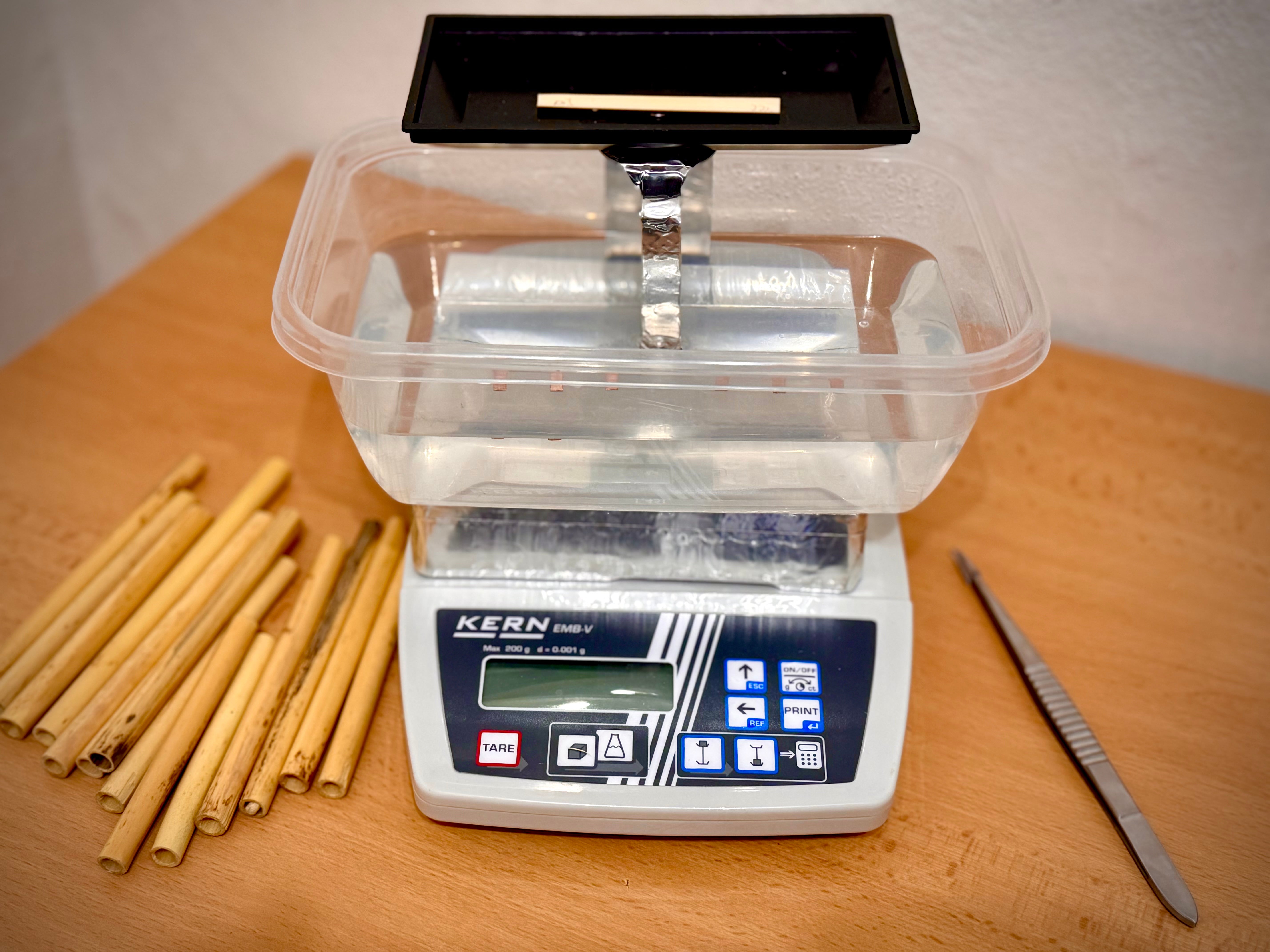
For density testing I use a KERN EMB 200-3V balance with integrated density determination.
The balance has a maximum weighing capacity of 200 g and a readability of 0.001 g, which makes it suitable for measuring the small samples used in oboe reed making.
The density measurement is based on Archimedes’ principle.
The cane is first weighed in air and then while completely submerged in water. After the density of the water has been entered, the balance automatically calculates and displays the density of the sample.
Because oboe cane has a density lower than water and naturally floats, the sample must remain completely submerged during the second measurement.
For the measurement to be useful, consistency is essential.
I pay attention to:
-
preparing every piece to the same stage,
-
fully submerging the cane,
-
preventing the sample from touching the container,
-
avoiding trapped air bubbles,
-
and using the correct density value for the water temperature.
At approximately 22 °C, I use a water-density value of:
0.9978 g/cm³
Even small changes in water temperature slightly change its density, so I prefer to adjust this value according to the actual temperature rather than using the same value automatically for every measurement.
3. Why I Measure Density After Pre-Gouging
One of the most important things I discovered when introducing density testing into my reed-making process was that the stage at which the cane is measured matters.
Initially, I measured density at the split-cane stage.
At that stage, my working classification was approximately:
-
Medium density: 0.58–0.64 g/cm³
-
High density: 0.65–0.72 g/cm³
However, I wanted to know what would happen to these values after material was removed from the inner surface of the cane.
I therefore compared a substantial number of the same individual pieces twice — first as split cane and then again after pre-gouging.
The difference was significant.
In all of my paired comparisons, the density measured after pre-gouging was higher than the value measured from the same piece at the split-cane stage.
This makes sense because cane is not structurally uniform through the thickness of its wall.
When material is removed from the inner surface during pre-gouging, the physical composition of the remaining piece changes.
A density value measured from split cane therefore should not simply be treated as equivalent to a density value measured after pre-gouging.
For this reason, I standardised my process.
I now evaluate density after pre-gouging, at a defined and repeatable stage of preparation.
The most important factor is not simply the number itself.
It is that every piece is prepared and measured under the same conditions, so the results can be compared meaningfully.
4. Split Cane vs Pre-Gouged Cane — What My Own Testing Showed
Comparing exactly the same pieces before and after pre-gouging made the difference particularly clear.
Below are some examples from my own measurements showing some of the largest differences I recorded:
| Split cane | Pre-gouged cane | |
|---|---|---|
| 0.695 | 0.781 | |
| 0.611 | 0.764 | |
| 0.690 | 0.839 | |
| 0.611 | 0.756 | |
| 0.578 | 0.723 | |
| 0.627 | 0.799 | |
| 0.671 | 0.799 | |
| 0.723 | 0.861 | |
| 0.669 | 0.807 | |
| 0.723 | 0.854 |
All values are in g/cm³. Each row represents the same individual piece of cane measured at two different stages of preparation.
Across the complete set of paired measurements, the average increase after pre-gouging was approximately:
+0.116 g/cm³
Importantly, the size of the change was not identical for every piece.
This is why I do not use a single correction factor to convert a split-cane density value into a pre-gouged value. Instead, I measure each piece directly at the stage that is relevant to my current reed-making process.
For my current workflow, pre-gouged density is the reference.
My Working Density Scale After Pre-Gouging
Because the density values changed considerably after pre-gouging, my original split-cane ranges could not simply be transferred unchanged.
Using my paired measurements as a reference, the original split-cane ranges correspond approximately to the following practical working ranges after pre-gouging:
-
Medium density: approximately 0.72–0.77 g/cm³
-
High density: approximately 0.78–0.83 g/cm³
These are my own practical working ranges, developed from measurements made within my preparation and testing system.
They are not intended as universal density standards for oboe cane.
Values outside these ranges are still measured and evaluated individually. In my testing, some pieces produced pre-gouged density values substantially above 0.83 g/cm³.
A higher number does not automatically mean a better piece of cane.
Density remains one part of the overall material profile and must be considered together with hardness, flexibility, diameter and ultimately the behaviour of the finished reed.
The most important lesson from these comparisons was therefore not simply that density increased after pre-gouging.
It was that density becomes a useful selection parameter only when the preparation stage and measurement method are standardised.
5. An Important Limitation of Density Testing
Oboe cane is a natural, porous and hygroscopic material.
Unlike a completely impermeable solid, cane can interact with moisture.
This means that hydrostatic density measurement must be performed consistently if the results are to be useful for comparison.
Factors such as:
-
moisture condition of the cane,
-
water temperature,
-
immersion procedure,
-
trapped air,
-
preparation stage,
-
and measurement consistency
can influence the result.
For this reason, I use density testing primarily as a comparative material-selection tool within my own reed-making process.
I do not consider one density measurement to be a complete description of a piece of cane.
Its value comes from comparing pieces using the same preparation and measurement method.
6. Density Is Not the Same as Hardness
This distinction is essential.
Density and hardness describe different properties of cane.
A relatively dense piece does not automatically have to be exceptionally hard.
Likewise, cane that gives a harder reading does not automatically have the highest density.
There may be relationships between different properties of the material, but one measurement cannot reliably replace another.
This is why I do not select cane using density alone.
After final gouging, I perform a separate hardness test.
7. How I Measure Cane Hardness
I use a digital hardness tester on gouged cane.
The purpose is not to search for the hardest cane possible.
The purpose is to add another objective and repeatable parameter to the material-selection process.
On the testing system I use, lower numerical values represent harder cane.
My general working range is approximately:
10–14
Within this range, I refine the selection according to the type of reed I am making.
For my current reeds, I generally use:
-
Professional Oboe Reed: 10–13
-
Student Oboe Reed: 11–14
These values belong to my particular testing system and measurement procedure.
They should not be interpreted as a universal hardness scale that can automatically be compared with another tester or another reed maker.
Their value is in making measurements repeatable within the same system.
8. Hardness Is Not Flexibility Either
Density and hardness still do not tell me everything about how a piece of cane will behave.
Two pieces may have similar density and similar hardness readings yet react differently when they are bent.
This is why I also evaluate:
flexibility.
For this part of the process I use a K.GE Flexibility Tester on gouged cane.
The test gives me another way of comparing how individual pieces respond to bending under the same measurement procedure.
For my current reed selection I generally use:
-
Professional Oboe Reeds: medium flexibility
-
Student Oboe Reeds: medium-soft flexibility
Again, one is not automatically “better” than the other.
The aim is to select a combination of properties appropriate for the type of reed I want to make.
9. Why I Test Density, Hardness and Flexibility Separately
The easiest way to understand my system is to consider the three measurements individually.
Density
describes the mass-to-volume relationship of the prepared cane.
Hardness
provides information about how the material responds to a defined hardness measurement.
Flexibility
provides information about how the gouged cane behaves when it is bent.
A piece can therefore be relatively dense without being exceptionally hard.
Two pieces can have similar hardness values but different flexibility.
And two pieces with similar density can ultimately behave quite differently during reed making.
This is precisely why I prefer not to judge cane from a single number.
Natural cane is too complex for that.
10. How Testing Fits Into My Reed-Making Process
Material testing is one part of a much larger process.
My current sequence is approximately:
-
Visual inspection and initial cane selection.
-
Diameter selection.
-
Pre-gouging.
-
Density testing.
-
Final gouging.
-
Hardness testing.
-
Flexibility testing.
-
Shaping.
-
Tying and reed making.
-
Scraping and final adjustment.
-
Playing test.
Each stage gives me information that the previous one cannot provide.
Density testing does not replace hardness testing.
Hardness testing does not replace flexibility testing.
And none of these measurements replaces the practical experience required to finish a reed.
They simply allow me to make better-informed material choices before reaching the final playing test.
11. How I Use These Measurements for Student and Professional Reeds
The purpose of testing is not to find the cane with the highest possible numbers and call it the best.
Different reeds require different combinations of material characteristics.
For my Student Oboe Reeds, I select medium-density cane, generally within a hardness range of 11–14 and with medium-soft flexibility.
The aim is comfortable response, manageable resistance and reliable playing characteristics for students and developing players.
For my Professional Oboe Reeds, I select high-density cane, generally within a hardness range of 10–13 and with medium flexibility.
But there is an important distinction:
high density does not automatically mean professional quality.
A piece is not selected for a Professional reed simply because its density value is high.
Density must work together with:
-
hardness,
-
flexibility,
-
cane diameter,
-
gouge,
-
shaper form,
-
staple,
-
scrape,
-
opening,
-
and final adjustment.
Likewise, cane selected for a Student reed is not simply inferior material.
It is selected according to a different material profile and for a different playing goal.
12. Does Higher Density Make a Better Oboe Reed?
Not necessarily.
It would be tempting to simplify cane selection into statements such as:
higher density = better reed
or:
higher density = darker sound
but the finished reed depends on many variables working together.
These include:
-
density,
-
hardness,
-
flexibility,
-
cane diameter,
-
gouge,
-
shaper form,
-
staple,
-
scrape,
-
opening,
-
instrument,
-
embouchure,
-
and playing style.
Density helps me classify and select material more consistently.
It does not tell me exactly how the finished reed will sound or how it will feel to an individual player.
The same applies to hardness and flexibility.
These measurements provide information.
They do not make the reed.
13. Measurement Helps — Playing Decides
Modern measuring tools give me information about cane that I cannot obtain reliably from appearance alone.
But my goal is not to turn handmade reed making into a collection of numbers.
A density measurement cannot hear the reed.
A hardness tester cannot judge articulation.
A flexibility tester cannot tell me whether the finished reed has the response, stability or tonal character I am looking for.
Measurements help me make better-informed decisions during material selection and preparation.
The final decision is still made by playing.
Every finished reed is tested and adjusted as a musical component before it leaves my workshop.
That final playing test remains the most important one.
Frequently Asked Questions
Is high-density cane always better for oboe reeds?
No. Density is only one characteristic of the material. High-density cane still needs the appropriate combination of hardness, flexibility, diameter, gouge and other properties to produce a successful reed.
Are cane density and hardness the same thing?
No. They describe different properties. Cane with similar density can have different hardness, and harder cane is not automatically the densest cane.
Why measure flexibility if the cane has already been tested for hardness?
Because hardness does not completely describe bending behaviour. Two pieces with similar hardness readings may still have different flexibility.
Why do you measure density after pre-gouging?
Because the physical state of the sample matters. Removing material from the inner side changes the remaining cane. Measuring every piece at the same pre-gouged stage gives me a much more useful basis for comparison.
Does cane density determine the sound of the finished reed?
Not by itself. Tonal character and playing behaviour depend on the complete reed design and on the interaction between the reed, instrument and player.
Are your density and hardness values universal standards?
No. They belong to my own preparation and measurement system. Their purpose is to improve consistency and allow meaningful comparisons within my reed-making process.
Final Thoughts
Working with natural cane will always involve variation.
That is part of what makes reed making both challenging and fascinating.
Density, hardness and flexibility allow me to understand some of that variation more clearly, but none of them defines the quality of a finished reed on its own.
For me, the real value is in combining objective measurement with practical reed-making experience.
The measurements help me select the material.
The reed-making process brings all of those characteristics together.
And playing tells me whether the decisions worked.
The goal remains simple:
a responsive, stable and musically flexible oboe reed that allows the player to concentrate on the music.
You can explore how these material-selection principles are applied across my collection of handmade oboe reeds.
About the Author
Peter Kovács is a professional oboist and reed maker from Banská Bystrica, Slovakia. He has more than twenty years of experience in oboe playing and reed making and has served as Principal Oboist of the State Opera in Banská Bystrica since 2012.
His European-style handmade oboe reeds are created with a focus on response, stability, flexibility, intonation and tonal character

